Plywood is the part of your interiors you will never see again once the laminate (or other finishing materials) goes on. It is also the part that decides whether your kitchen base units are still solid in ten years, or swelling at the bottom after the third monsoon.
Most quotes mention a grade: MR, BWR or BWP. Few explain what the letters mean or why one costs more than another. This guide does both, room by room.
What plywood is, and why the glue matters most
Plywood is made of thin wood veneers stacked with the grain of each layer at right angles to the next, then bonded under heat and pressure. The cross-layering is what makes it strong and stable.
The grade, though, is mostly about the adhesive. A board’s resistance to moisture depends heavily on the resin that holds those layers together. That is why two sheets that look identical can behave very differently next to a sink.
The three grades
MR: moisture resistant
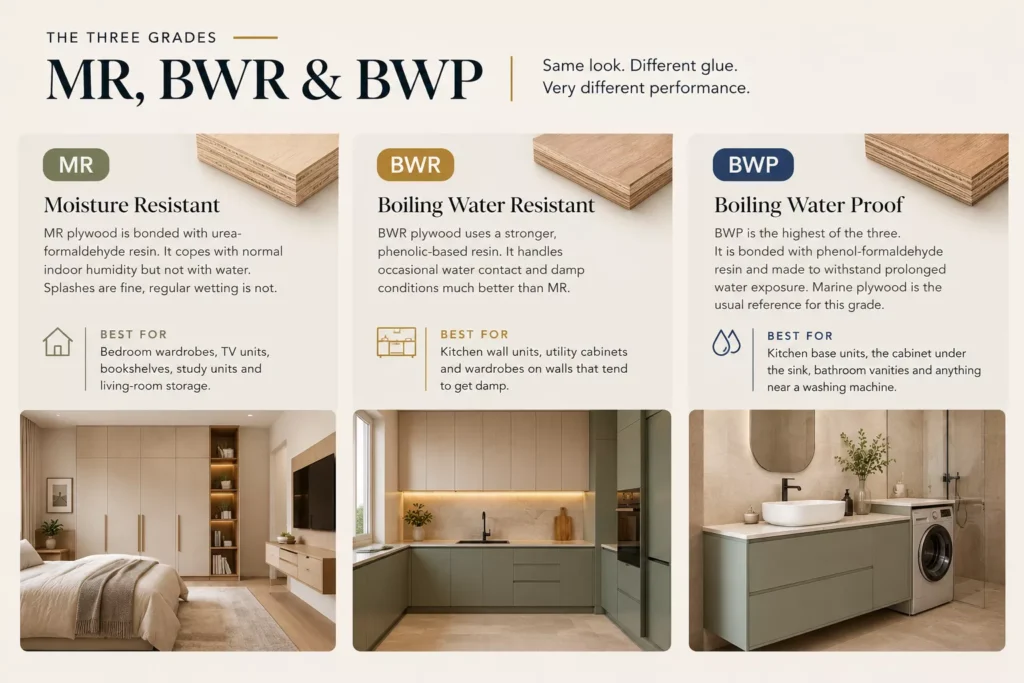
MR plywood is bonded with urea-formaldehyde resin. It copes with normal indoor humidity but not with water. Splashes are fine; regular wetting is not.
Use it for dry areas: bedroom wardrobes, TV units, bookshelves, study units and living-room storage.
BWR: boiling water resistant
BWR plywood uses a stronger, phenolic-based resin. It handles occasional water contact and damp conditions much better than MR.
Use it for kitchen wall units, utility cabinets and wardrobes on walls that tend to get damp.
BWP: boiling water proof
BWP is the highest of the three. It is bonded with phenol-formaldehyde resin and made to withstand prolonged water exposure. Marine plywood is the usual reference for this grade.
Use it wherever water is a daily fact: kitchen base units, the cabinet under the sink, bathroom vanities and anything near a washing machine.
| Grade | Indian standard | Handles | Best for | Avoid for |
|---|---|---|---|---|
| MR | IS 303 | Indoor humidity | Wardrobes, TV units, study, bookshelves | Kitchens, bathrooms, utility |
| BWR | IS 303 | Occasional water, damp | Kitchen wall units, utility, damp walls | Under-sink, vanities |
| BWP / marine | IS 710 | Prolonged water exposure | Kitchen base units, under-sink, vanities | Nothing; it is simply the most expensive |
Why Hyderabad homes need to think about this
Hyderabad is dry for much of the year, which tempts people to use MR everywhere. But the kitchen sink sees water every day, monsoon humidity sits in closed cabinets, and a leaking pipe behind a unit can go unnoticed for weeks.
The cost of getting this wrong is not the plywood. It is ripping out a kitchen base unit to fix swelling, which usually means redoing the countertop too.
A sensible split for most apartments:
- Kitchen base units and under-sink: BWP
- Kitchen wall units: BWR or BWP
- Bathroom vanities: BWP
- Utility and washing-machine areas: BWP
- Wardrobes on exterior or bathroom-facing walls: BWR
- Other wardrobes, TV units, study and living storage: MR or BWR, depending on budget
Thickness: what goes where
Grade is half the story. Thickness decides how much load a unit can carry and how well it holds screws and hinges.
| Part | Typical thickness |
|---|---|
| Carcass sides, top and bottom | 16 mm |
| Shelves | 16 mm, especially on wider spans |
| Shutters | 16 mm |
| Back panels | 6 to 9 mm |
| Drawer bottoms | 6 to 9 mm |
Thin shelves on a wide span will sag under books or crockery over time. If a quote uses 12 mm for shelves, ask why.
What about HDHMR, MDF and particle board?
Plywood is not the only board on the market, and the alternatives have real uses.
- HDHMR (high density, high moisture resistance board) is dense and stays very flat. It works well for shutters and for designs routed by machine, such as grooved or fluted panels.
- MDF has a smooth surface that takes paint well, so it suits painted and PU-finished shutters in dry areas. Keep it away from water.
- Particle board is the cheapest option and is common in ready-made furniture. It does not hold screws well over repeated use and swells quickly when wet. We would not use it in a kitchen.
A mix is normal. Many good kitchens use BWP plywood for the carcass and HDHMR or MDF for the shutters.
Calibrated plywood and why it matters for shutters
Calibrated plywood is sanded to a uniform thickness across the whole sheet. Non-calibrated sheets can vary slightly from one spot to another.
On a carcass, a small variation rarely shows. On shutters it does: uneven thickness leads to doors that don’t sit flush and gaps that look different from one door to the next. For shutters and visible panels, calibrated board is worth it.
Block Board: What it is and where it is used
Block board is made using a core of solid wood strips placed side by side and bonded between layers of veneer. This construction gives the board good strength and rigidity while keeping it relatively lightweight. It is particularly useful for longer furniture components, wide shelves, partitions, doors where stability across larger spans is important.
In India, block boards are covered under IS 1659:2004, which specifies two grades:
- MR (Moisture Resistant): Suitable for interior applications such as furniture, partitions, panelling and ceilings.
- BWP (Boiling Water Proof): Designed for exterior applications and areas exposed to higher humidity, subject to the specified application requirements.
The standard also classifies block boards into decorative and commercial types, depending on the face veneers and intended finish.
At Chic Spaces, we use block boards for selected furniture applications where its strength, rigidity and lightweight construction offer an advantage. As with other boards, the grade, thickness, quality of the core and adhesive specification matter. Always check for the IS 1659 marking and the grade mentioned in your material specification.
Formaldehyde emissions
The resins used in plywood can release formaldehyde, especially when new. Boards are classified by emission level, with E1 and E0 among the lower-emission classes.
For bedrooms and children’s rooms in particular, ask which emission class the board meets. Airing the home well for the first few weeks after installation also helps.
How to check the plywood on your site
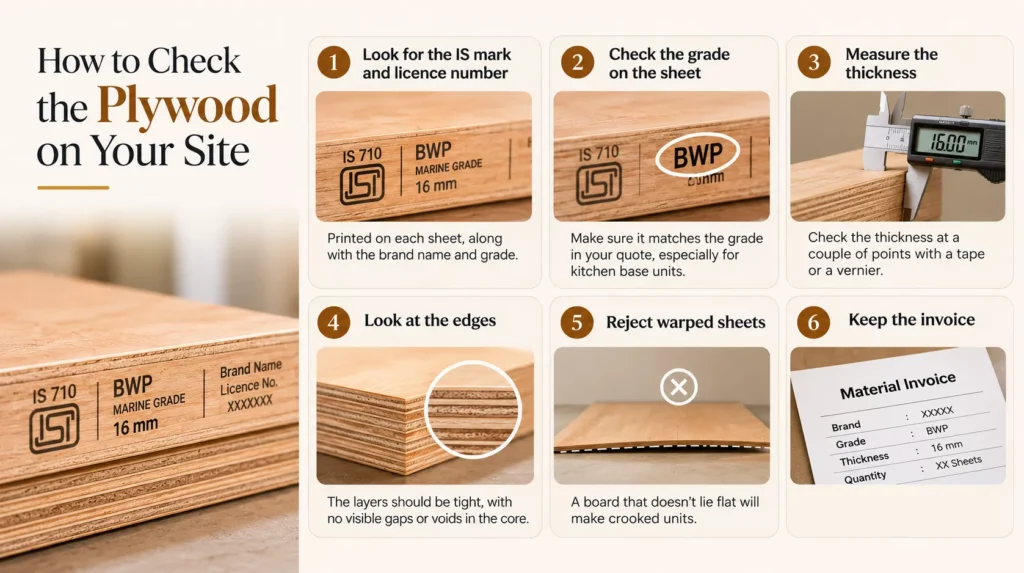
You don’t need to be an expert to catch the most common substitutions.
- Look for the IS mark and licence number printed on each sheet, along with the brand name and grade.
- Check the grade printed on the sheet matches the grade in your quote, especially for kitchen base units.
- Measure the thickness at a couple of points with a tape or a vernier.
- Look at the edges. The layers should be tight, with no visible gaps or voids in the core.
- Reject warped sheets. A board that doesn’t lie flat will make crooked units.
- Keep the invoice or the material list your studio gives you, with brand and grade named.
If the plywood is cut and laminated before it reaches your site, ask to see the boards at the workshop or ask for photos of the stamps before cutting.
How Chic Spaces handles materials
We run our own Material Depot in Hyderabad, so you can see and handle the boards, laminates and finishes before anything is ordered. You select the materials, you sign them off, and that is what goes into your home. Every specification is written into the final bill before work starts.
If you are comparing quotes, our guide to what an interior design quote should include shows how to read the material lines. Or book a visit and see the difference between grades for yourself.
Frequently asked questions
Which plywood is best for a kitchen?
BWP or marine-grade plywood for base units and the cabinet under the sink, where water contact is daily. BWR or BWP works for wall units.
Is BWR plywood waterproof?
No. BWR is water resistant: it handles occasional contact and damp conditions. For areas that get wet regularly, use BWP.
Can I use MR plywood for wardrobes?
Yes, for wardrobes in dry rooms. If the wardrobe sits on a wall that gets damp, such as one shared with a bathroom, BWR is safer.
Is HDHMR better than plywood?
Neither is better everywhere. HDHMR stays very flat and suits shutters and routed designs. Plywood is the more common choice for carcasses. Many good kitchens use both.
How do I know if my plywood is genuine?
Check for the IS mark, licence number, brand name and grade printed on each sheet, measure the thickness, and look for gaps in the core at the edges.